
0
0


In multifamily construction, cabinetry and interior finishes are only as good as their installation. While material selection often receives the most attention during procurement, installation quality is what ultimately determines performance, appearance, and long-term durability.
For this reason, more multifamily developers and general contractors are paying closer attention to who installs their cabinetry—not just what is being installed. Many teams are also turning to turnkey interior finish partners who manage both materials and installation under a single coordinated structure.
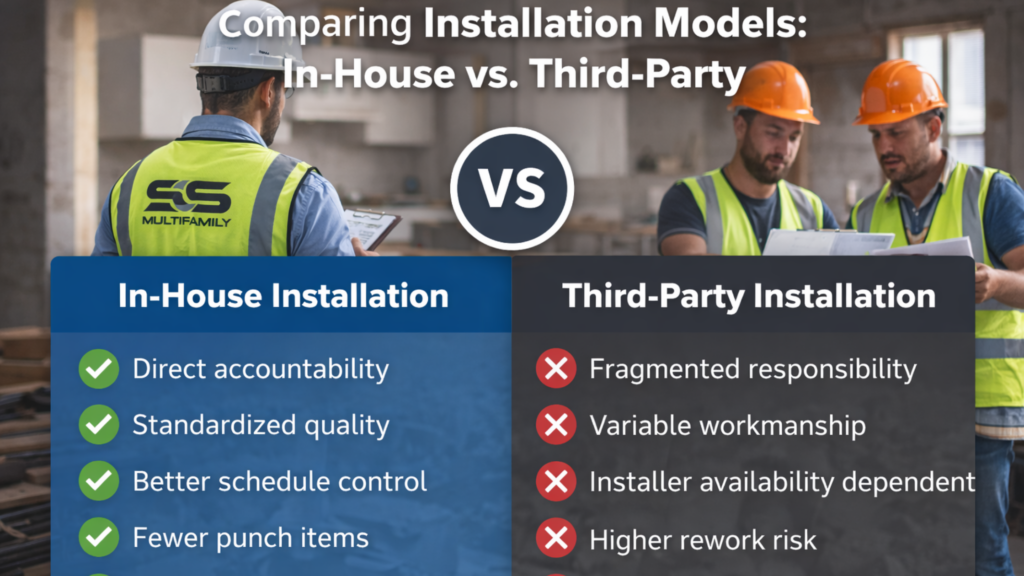
Many cabinet suppliers rely on third-party or rotating subcontracted installers. While this approach may appear cost-effective upfront, it frequently introduces challenges that surface later in the project lifecycle.
Common issues with third-party installation include:
Because installers are not directly tied to the supplier, responsibility can become fragmented—leading to delays, disputes, and additional cost exposure.
In-house installation means the same company responsible for supplying the cabinetry and interior finishes also employs, trains, and manages the installation teams performing the work on site.
This model creates a direct line of accountability from preconstruction planning through final turnover—eliminating the disconnect that often exists between supplier and installer.
In-house installers are trained to follow standardized installation methods, quality checks, and project-specific requirements. This consistency is especially critical on large-scale multifamily developments where repetition magnifies small errors.
When installation is performed in-house, there is no ambiguity around responsibility. Issues are addressed internally and efficiently—without shifting blame between vendors.
Because installation teams are managed directly, schedules can be adjusted proactively to align with site conditions, material deliveries, and construction sequencing.
Experienced, dedicated installation crews significantly reduce common field issues such as alignment errors, damaged finishes, improper clearances, and hardware failures.
In-house installation teams provide valuable feedback during preconstruction, helping identify potential challenges before materials ever arrive on site.
On multifamily projects with hundreds or thousands of units, installation inefficiencies multiply quickly.
A minor issue repeated across 300 units can result in:
In-house installation minimizes these risks by ensuring that every unit is installed to the same standard—regardless of building phase or location.
At SCS Multifamily, installation is treated as a core competency—not an afterthought.
By maintaining dedicated, in-house installation teams, SCS ensures that cabinetry, countertops, flooring, and interior accessories are installed with precision, consistency, and accountability. This integrated approach allows issues to be resolved quickly and keeps projects moving forward without unnecessary disruption.
For developers and general contractors, this means fewer surprises, cleaner turnovers, and greater confidence in the finished product.
Installation is more than a labor task—it plays a critical role in the overall success of a multifamily construction project. Even the highest-quality materials can fall short if they are not installed correctly and consistently.
Developers and builders who prioritize in-house installation gain stronger control over workmanship, project schedules, and final outcomes. As multifamily developments grow larger and more complex, that level of control becomes increasingly valuable.
Partnering with a provider that manages installation internally helps ensure greater consistency, clearer accountability, and more reliable performance from the first unit to the final turnover.